3D2HOLO vs Lentigram
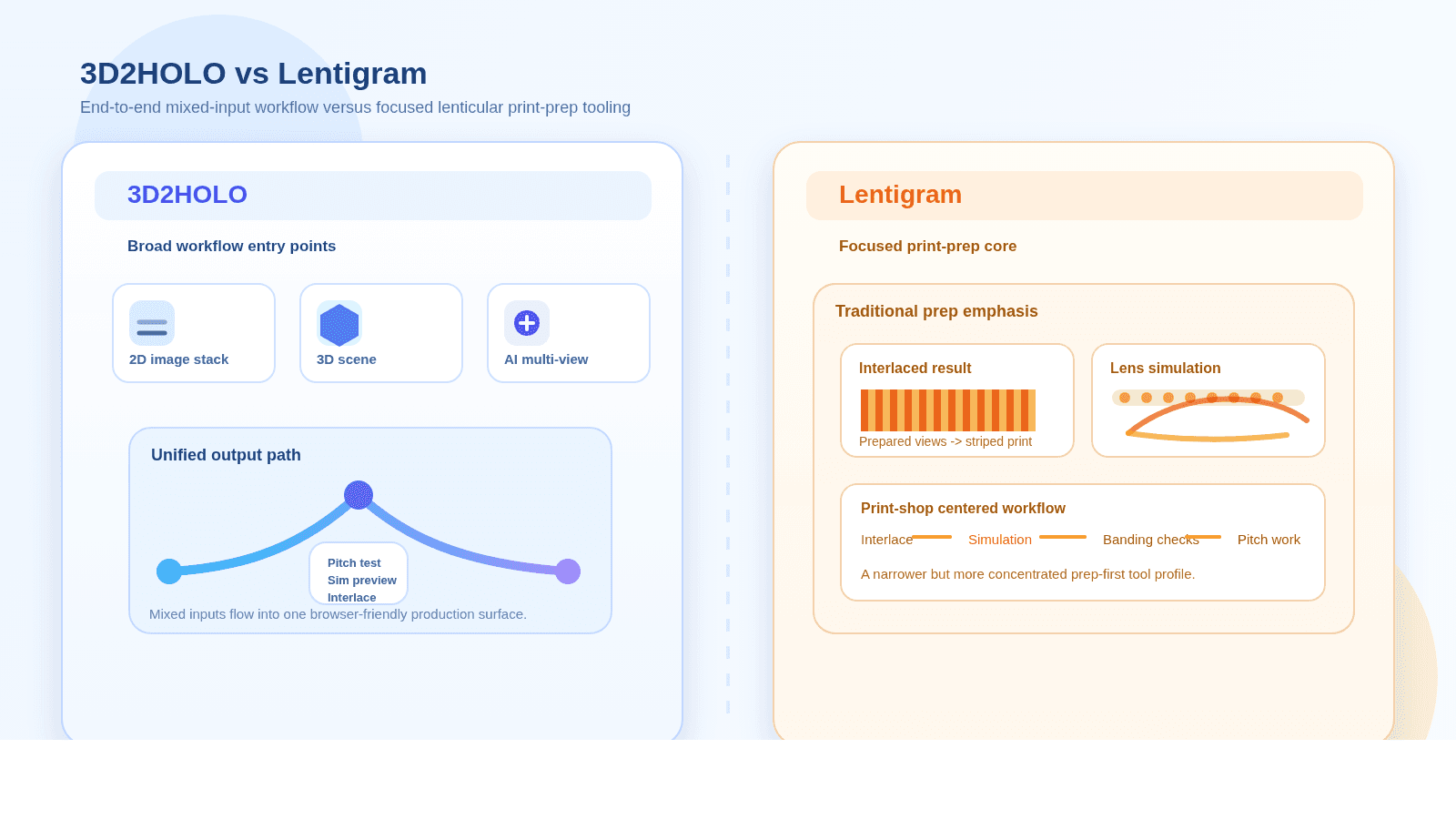
3D2HOLO and Lentigram are not trying to win in exactly the same way. Lentigram is easier to understand as a focused lenticular print-prep toolset. 3D2HOLO is easier to understand as a broader workflow that can start from 2D images, 3D scenes, Sketchfab assets, or AI-generated multi-view output and move those inputs toward lenticular-ready files inside one product surface.
Comparison note
This article reflects the current public 3D2HOLO workflow surface and publicly visible Lentigram product descriptions as of March 29, 2026. It compares workflow fit and product emphasis, not a certified one-to-one feature audit of every internal algorithm or print-shop edge case.
The short version
If your main job is classic lenticular print preparation and you want a narrower tool that centers on interlacing, simulation, and traditional print-oriented checks, Lentigram is the more specialized option. If your team needs one place to start from multiple asset types and move from idea to lenticular-ready output with less tool switching, 3D2HOLO is the stronger platform direction.
The real difference is not whether both products care about print. They do. The difference is that Lentigram appears more concentrated around established print-prep tasks, while 3D2HOLO stretches further upstream into asset intake, AI multi-view generation, browser-accessible workflow, and mixed-input production. 3D2HOLO also already includes pitch-test and simulation-style previewing, which means the comparison is less about missing the basics and more about how deep each product goes in traditional diagnostics versus end-to-end flexibility.
| Side-by-side comparison | 3D2HOLO | Lentigram |
|---|---|---|
| Primary product shape | End-to-end lenticular workflow platform | Focused lenticular print-prep toolset |
| Starting inputs | 2D sequences, 3D uploads, Sketchfab, and AI multi-view paths | More centered on prepared imagery for classic lenticular production |
| Print-prep utilities | Pitch test, interlacing, and simulation preview inside a broader workflow | Traditional print-prep style emphasis around interlacing and simulation tasks |
| AI and modern asset intake | Strong fit for AI-assisted and mixed-source production | Not mainly positioned around AI-first or mixed modern intake |
| Best fit team | Studios, creators, and product teams that want flexibility from intake to output | Operators who mainly need a dedicated lenticular prep environment |
| Main tradeoff | Broader system, more moving parts, and more product surface to maintain | Narrower scope, less coverage of upstream content generation and platform workflow |
3D2HOLO covers more than the print-prep middle
A clear advantage of 3D2HOLO is that it does not assume every job begins with a perfectly prepared source sequence. Teams can start from ordered 2D images, uploaded 3D assets, Sketchfab capture, or AI-generated view sweeps. That matters when the production problem is not only how to interlace, but also how to get enough usable viewpoints in the first place.
Pitch test and simulation are already part of the story
This comparison should not be framed as if 3D2HOLO lacks print-aware tools. It already includes pitch-test workflow and simulation-style result previewing. That means the real product question is whether a team wants those capabilities inside a wider modern production environment or prefers a more traditional, narrower tool focused mainly on lenticular preparation itself.
Lentigram's advantage is concentration, not breadth
Lentigram's appeal is that it appears to stay closer to the classic print-shop center of gravity. When the workflow is already stable and the main need is dedicated lenticular preparation rather than AI, browser review, or mixed asset intake, a concentrated tool can be simpler to adopt and easier to keep operational for that narrow purpose.
3D2HOLO can grow into the traditional strengths too
Because 3D2HOLO already has pitch testing, interlacing, and simulation preview, it is well positioned to deepen traditional print diagnostics over time without giving up the broader platform benefits. That creates a plausible path where one product handles both modern content generation and increasingly mature print-prep validation.
Choose 3D2HOLO when these points matter most
- You want one workflow that can begin from 2D, 3D, Sketchfab, or AI instead of assuming a fixed source pipeline.
- You want pitch testing and simulation preview without giving up a broader browser-friendly workflow.
- You expect mixed teams to review, iterate, and move between generation and print prep more fluidly.
- You care more about end-to-end flexibility than about using the narrowest possible dedicated prep tool.
When Lentigram may still be the better fit
If your workflow is already centered on classic lenticular production and the team mainly values a compact toolset for established print-prep tasks, Lentigram may still feel more direct. That can be especially true in environments where upstream content creation happens elsewhere and the software only needs to handle the traditional preparation stage.
So the strongest case for 3D2HOLO is not that Lentigram has no advantage. It is that 3D2HOLO makes a bigger bet on the whole workflow, from asset entry to lenticular-ready output. The strongest case for Lentigram is that a narrower, classic prep-first tool can still be exactly the right answer for print operators who do not need the rest of that platform surface.
Try the broader workflow directly
If your team wants to compare the difference in practice, the easiest test is to take a 2D image set, a 3D model, or an AI-assisted source and run it through a single 3D2HOLO workflow first.
Open the image generatorFAQ
Is 3D2HOLO just a replacement for Lentigram?
Not exactly. 3D2HOLO is broader in scope. Lentigram is easier to describe as a dedicated lenticular prep tool, while 3D2HOLO is built more like a wider workflow platform that also includes print-aware steps.
Does 3D2HOLO already cover pitch testing and simulation preview?
Yes. 3D2HOLO already includes pitch-test workflow and simulation-style previewing, so the comparison is not about lacking those basics. It is more about depth of traditional diagnostics versus platform breadth.
Who should still prefer Lentigram?
Teams that mainly need a compact, traditional lenticular preparation environment and do not need broader AI, 3D, or mixed-source workflow support may still prefer Lentigram.